Click on one of the following categories to be sent to the appropriate page.
White
The Snail
Agara
The Albis
PE'TUK LERYN
The Inheritor of Wisdom
A Citizen's Account of the City and Its People
As told by someone who has spent a lifetime beneath the protection of its walls.
The City That Endures
There are finer places in the world, or so the merchants will tell you. Cities with taller towers, richer princes, and markets where a man can buy a thousand things he's never heard of and doesn't need.
Perhaps they're telling the truth. Merchants have been known to do that occasionally.
But I've traveled beyond our borders, and I will tell you this: there are precious few places where a man can expect to eat tomorrow, where his children can sleep without fear, and where the laws are the same this year as they were when his grandfather was born.
That is Pe'tuk Leryn.
Our name means Inheritor of Wisdom, and there is a reason for it.
We did not build our city upon empty ground. Beneath our streets lie the foundations of a people older than any living kingdom. Their walls crumbled, their kings disappeared, and much of their knowledge was lost. But something of their wisdom survived, carved upon stone and preserved in the records of those who came after.
Our ancestors gathered what they could and built anew.
We have preserved their laws as faithfully as we know how. There are scholars who argue over the meaning of ancient words, of course. Scholars will argue over anything if someone provides them with enough grain and a place to sit.
But the laws have served us well.
Look at our walls. Look at our granaries. Look at our children playing in the streets.
We have endured.
And that is no small accomplishment.
Within the Walls
Some twenty-five thousand souls live within Pe'tuk Leryn's walls, with many thousands more in the villages, farms, and settlements that look to our city for protection.
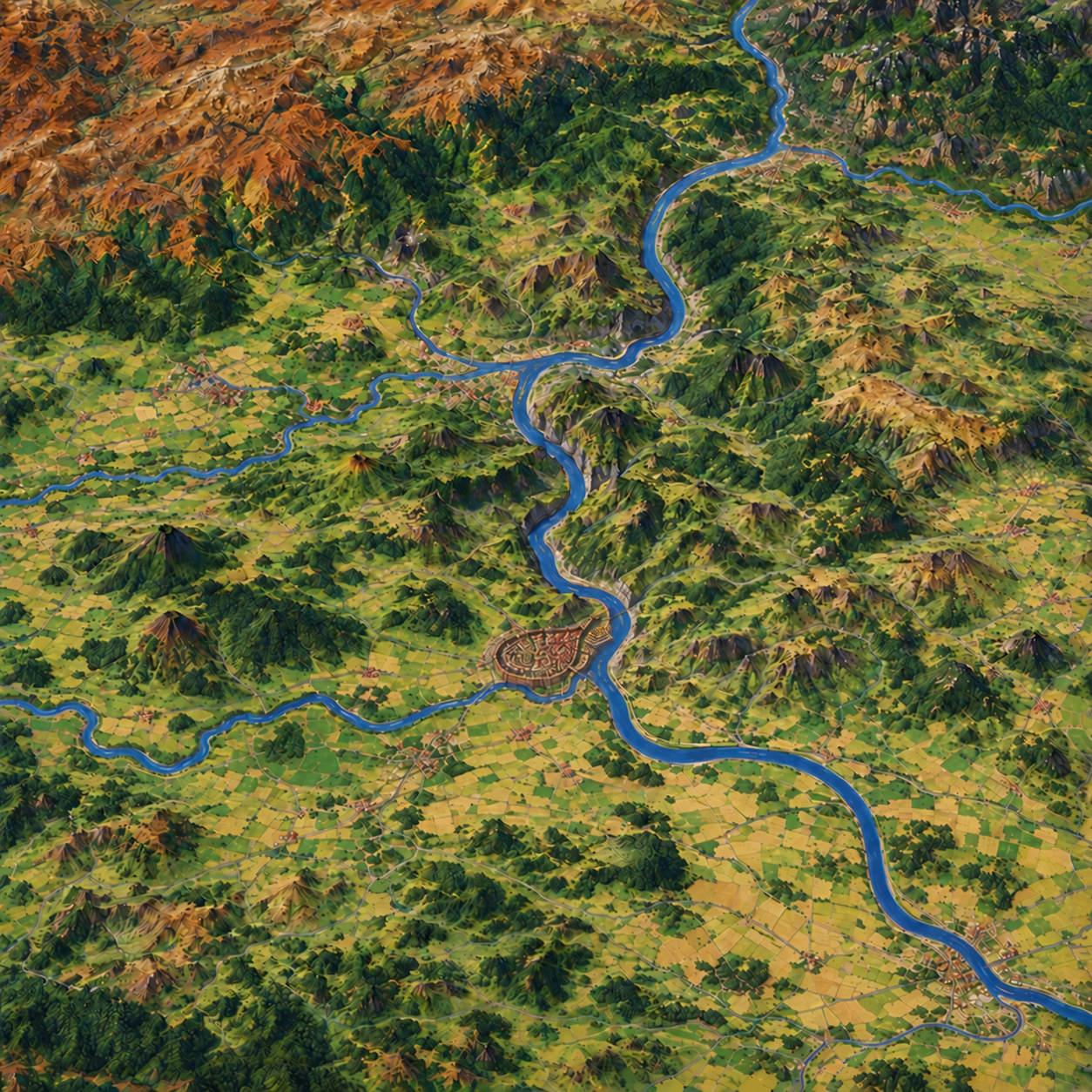
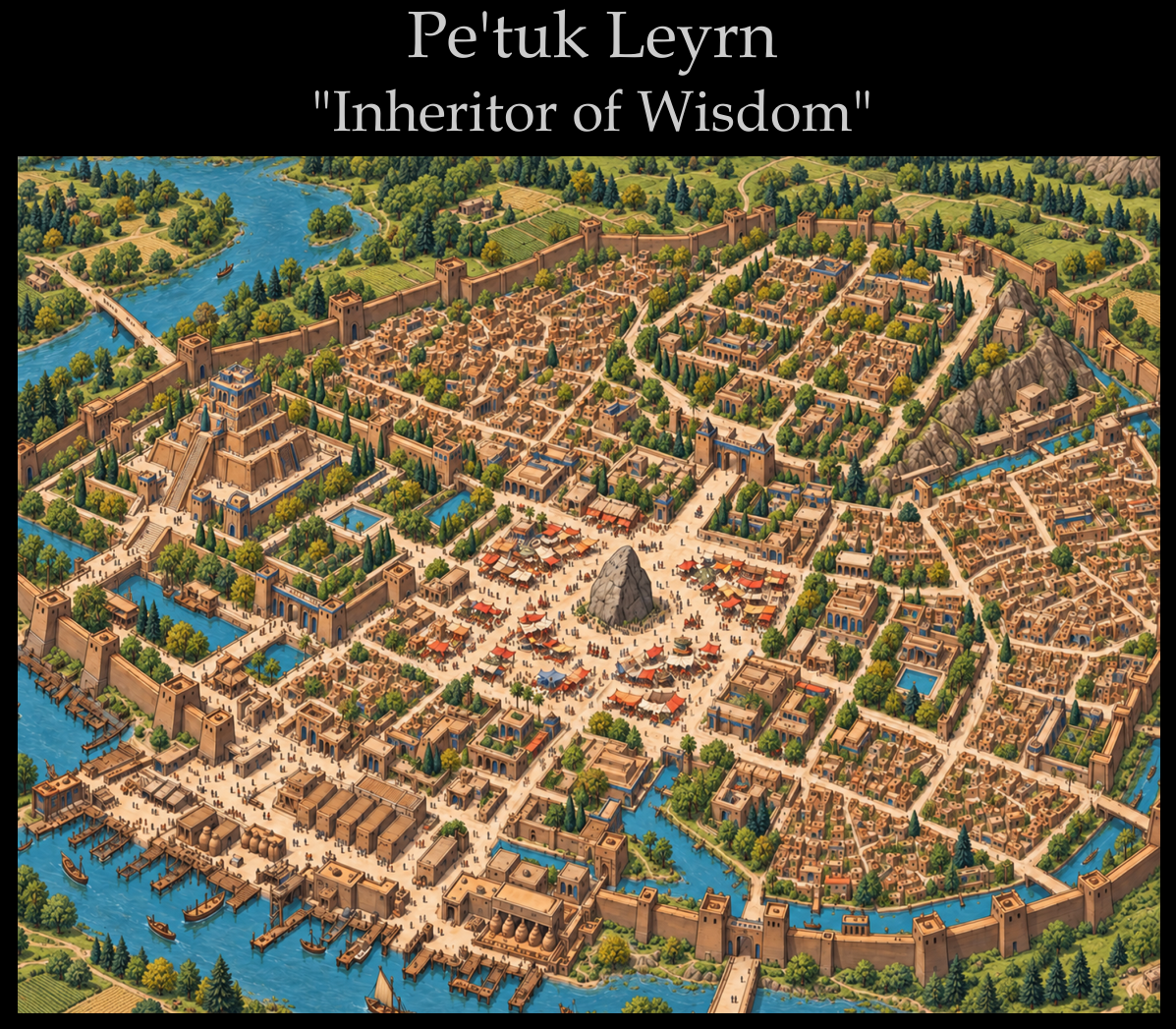
The city is built beside a broad, navigable river. Barges carry grain and timber from upstream, and merchant vessels bring goods from distant communities. Our docks are rarely quiet.
There are neighborhoods of craftsmen, merchants, laborers, soldiers, and wealthy householders. The streets nearest the markets are crowded and noisy. Elsewhere you will find gardens, courtyards, small workshops, and houses belonging to families who have occupied the same ground for generations.
Our walls are thick and well maintained. The gates are guarded, the canals kept clear, and the granaries regularly inspected.
There is work here for those willing to do it.
Carpenters, masons, potters, weavers, traders, boatmen, farmers, scribes, soldiers, and countless others all contribute to the city's prosperity.
During the festivals, the market plazas fill with music, dancers, food sellers, and families enjoying themselves.
Our city is not without its troubles. There are thieves, dishonest merchants, corrupt officials, and the occasional violent dispute.
But there are laws for such things, and people charged with enforcing them.
Most of us sleep comfortably at night.
I have visited places where that would be considered an extraordinary luxury.
The Stone That Knows Us
At the heart of our great marketplace stands the Stone.
You cannot miss it.
It rises from the plaza, enormous and ancient, a rough monument of gray rock that was already old when our earliest surviving histories were written.
No king placed it there. No mason carved it. As far as anyone knows, the Stone has always stood where it stands today.
And something lives within it.
The spirit of the Stone is the great protector of Pe'tuk Leryn. Its presence is felt most strongly near the marketplace, though its influence reaches farther than most ordinary spirits could ever hope to manage.
Do not expect to converse with it.
The Stone does not speak as men do, nor does it appear especially interested in our arguments, marriages, debts, or politics.
It knows us in its own fashion.
Foreigners often find the Stone unsettling. They speak of an uncomfortable feeling near the marketplace, as though someone were watching them from behind.
Some become irritable. Others feel strangely out of place.
That is simply the Stone discovering who they are.
In time, the feeling usually passes.
I knew a merchant from the western hills who visited our city for nearly twenty years. On his first visits, he would not approach the marketplace unless business demanded it. Now he spends his afternoons there and says he feels more at home beside the Stone than in the village where he was born.
The Stone has grown accustomed to him.
Our children are introduced to the Stone almost from birth.
An infant will often fuss or cry when brought close to it. Mothers and fathers bring their little ones back again and again, until one day the child settles peacefully against the ancient rock.
We say the Stone has learned the child.
The elderly are especially fond of the plaza. You will find them gathered around the Stone in nearly every season, gossiping, playing games, arguing about the weather, or simply resting in its presence.
They say it feels like being among old friends.
My grandfather used to sit there for hours.
He said the Stone remembered him when everyone else had forgotten the boy he once was.
I cannot tell you whether that is true.
But when he grew too frail to leave his bed, he asked to be carried to the plaza one last time.
We carried him.
And he smiled.
The River and the Tall House
The Stone is not our only great spirit.
The river has a spirit of its own, powerful and ancient, though quite unlike the guardian of our marketplace.
The Stone is concerned with what remains.
The River knows what passes.
Its waters bring merchants and travelers, nourishing our fields and carrying our goods to distant places. But those same waters can destroy homes, drown the careless, and sweep away the works of generations.
The River does not appear to care whether someone is a foreigner or a citizen of Pe'tuk Leryn.
It has carried both for longer than anyone remembers.
Its great shrine is the Tall House, the stepped temple rising near the river within our walls.
There, priests and attendants maintain the ceremonies associated with the river and oversee many of the city's religious affairs.
They also maintain records, teach scribes, administer estates, and help supervise stores of grain and other provisions.
The river's spirit is sometimes said to know things that have passed along its waters. Boatmen occasionally seek its favor before difficult journeys, and its priests observe changes in the current, unusual floods, and other signs.
Whether the River pays attention to every prayer is another question.
A boatman once told me he had offered the River a perfectly good silver ornament before beginning his voyage, only to run aground before sunset.
His wife told him the River probably had no use for silver.
I suspect she was right.
The Stone and the River are both honored, but their natures are different. The Tall House stands apart from the Stone's marketplace, with its own precinct, traditions, and ceremonies.
We are fortunate to live under the influence of two such remarkable spirits.
Most settlements possess nothing comparable.
The Lesser Spirits
Outside the city, the world is full of spirits.
There are spirits in old trees, deep pools, ancient stones, particular hillsides, and places where generations of people have gathered.
Some are scarcely stronger than a whisper. A little spirit might possess no more than a few paces around its particular stone or spring.
Others influence entire groves, hills, or stretches of countryside.
They are not all alike.
Some tolerate travelers readily. Others are indifferent. Still others take offense at the presence of strangers, particularly those who disturb what they consider their own.
It is wise to respect such places.
A farmer may leave an offering beside an old tree before clearing nearby ground. A traveler might greet a roadside shrine. Boatmen learn which bends of the river are best approached quietly.
These customs do not guarantee safety.
Spirits are not people, and they do not always understand our intentions.
A man may mean no harm and still offend one.
Neither should you expect every spirit to possess the power of the Stone or the River. Most are small beings concerned with small places.
And there are places where no spirit holds sway at all.
Such country is not necessarily dangerous, but experienced travelers are cautious of it. Strange creatures and unnatural disturbances sometimes appear in unprotected lands, especially where other misfortunes have accumulated.
That is one reason our roads, patrols, villages, and fortified settlements matter so much.
The Three Obligations
Pe'tuk Leryn has endured because its people remember three obligations.
Keep the granaries filled.
Keep the gates defended.
Keep the hearths undisturbed.
You will hear these words throughout the city.
Children learn them early. Officials swear to uphold them. Magistrates invoke them when settling disputes.
The First Obligation means that food must be stored against famine and that fields, canals, and agricultural arrangements must be maintained.
The Second means that the city must defend its people, its roads, and the communities that depend upon its protection.
The Third means that households, inherited customs, and the established order of the city must be preserved.
They sound simple enough.
Of course, people have argued about what they mean for generations.
A grain assessment that protects the city against famine might impoverish a particular household. Soldiers sent to defend a distant village cannot simultaneously guard the walls. A law intended to preserve the order of households may bring suffering to individual families.
These are difficult matters.
That is why we have magistrates, stewards, assemblies, and scribes.
And why we spend so much time arguing with them.
The Price of Protection
There is something every child of Pe'tuk Leryn learns.
The walls protect us because we maintain them.
The granaries feed us because we fill them.
The soldiers defend us because we provide for their service.
No one receives the city's protection without accepting some responsibility for preserving it.
Households owe assessments of grain, goods, labor, or other recognized service according to their circumstances and standing.
These obligations are recorded and enforced.
Some wealthy families possess ancient privileges, and those privileges are not always fair. Nevertheless, even the powerful are expected to contribute to the city's survival.
When a household cannot meet its obligations, there are procedures for making good the deficiency. Relatives may assist. Patrons may advance supplies. Officials may allow time for repayment or arrange service.
But obligations cannot simply be ignored.
A household residing within the walls that repeatedly fails its obligations may eventually face a difficult choice.
It can relinquish its right to reside within the city and establish itself in the surrounding protected countryside.
Or it may surrender a child into the service and care of the city.
Those outside the walls have fewer privileges. Families living in the protected countryside also owe assessments, and persistent failure can result in a child being taken into civic service.
Those who reject such obligations altogether must abandon the city's protection and jurisdiction.
This is a serious matter, and no decent person celebrates it.
But the law is ancient, and most citizens believe it necessary.
The children taken into civic service become wards of the city.
Some are trained as scribes, temple attendants, administrators, pages, or skilled craftsmen. Others work in the granaries, fields, workshops, or on civic projects.
They are fed, housed, and assigned duties according to their abilities and the city's needs.
Many grow to become respected members of the community.
Some even rise to positions their birth families could never have imagined.
Others lead hard lives.
There are those who argue that the practice should be changed, and there are officials who work diligently to prevent families from reaching such desperate circumstances.
But most of us remember why these obligations exist.
Beyond our borders are places where a failed harvest means starvation, where walls are left unrepaired, and where families are carried away by raiders.
Here, we have laws.
Harsh laws, perhaps.
But we have survived under them.
Those Who Govern
The First Steward, Ashur-Tel, is the foremost official of Pe'tuk Leryn.
He has governed through years of negotiation, disputes, and difficult decisions. Some say he compromises too readily. Others say his willingness to compromise is the reason we have enjoyed so many years of peace.
The city is not his personal property, nor does he rule entirely alone.
The Assembly of Obligations brings together powerful householders, officeholders, religious authorities, merchant interests, and representatives of communities possessing recognized privileges.
It is not an assembly in which every citizen has an equal voice.
Such a thing would strike many inhabitants as a peculiar way to conduct serious business.
The city also relies upon several important officials.
Namarra, Keeper of Measures, oversees assessments, agricultural records, and grain reserves.
Bel-Kareth, Master of the River, manages river commerce, tolls, shipping arrangements, and important trading privileges.
Uruk-Sen, Captain of the Gates, commands the professional guard and coordinates the city's defenses.
Then there are the great households, whose lands, wealth, retainers, and ancient rights give them considerable influence.
There are always disagreements among these people.
Some want stronger government. Others fear placing too much authority in one person's hands.
Some wish to preserve every ancient custom. Others believe our ancestors were wiser than we are precisely because they knew when to change.
Most disputes are settled through negotiation, formal obligations, and the exchange of favors.
Occasionally, things become considerably less civilized.
But Pe'tuk Leryn has survived worse disagreements than the ones presently troubling its leaders.
Magick and Its Practitioners
You may encounter practitioners of magick within our city.
Do not confuse them with the spirits or those who serve the spirits.
They are quite different.
Magick can accomplish remarkable things, but every sensible person understands that it carries a price.
Sometimes that price is obvious.
Sometimes it is not.
Some magick-users enjoy excellent reputations. They may work for merchants, wealthy households, civic officials, or religious institutions.
Others practice independently.
A few are feared, especially when their abilities involve disturbing alterations, dangerous forces, or matters best left concealed.
There is no single guild that governs all practitioners. Instead, many operate under the protection or sponsorship of respected households and institutions willing to answer for their conduct.
If you employ a magician, it is wise to understand what you have been promised.
And wiser still to ask what it might cost.
As for the spirits, there are priests and other specialists who can sometimes sense their presence or interpret their wishes. A few have remarkable relationships with particular local powers.
But spirits are not servants, and even a priest who has spent a lifetime tending a shrine may understand very little about the being that inhabits it.
Our Near Neighbors
Farther from the central city are numerous settlements that acknowledge Pe'tuk Leryn's authority and rely upon its protection.
Some are prosperous. Others struggle.
There are villages whose inhabitants have scarcely seen the city's walls, though their grain and labor help sustain them.
Their loyalty is important.
So is our willingness to defend them.
A city that demands obligations without fulfilling its own will not retain its friends forever.
Our Far Neighbors
Pe'tuk Leryn is independent, but it does not exist alone.
Upstream lies Dur Halim, a powerful city-state with which we maintain extensive commercial and diplomatic relationships.
Its merchants are familiar faces in our markets.
Its rulers are less welcome whenever disagreements arise over river traffic, water rights, agricultural expansion, or trading privileges.
Nevertheless, we have traded with Dur Halim for generations, and neither city benefits from unnecessary war.
There is the realm of the Deep Ones, odd folk living under the mountains that loom over the distant ridges.
The rare arrival of their traders often invokes festivals across our valley, and while their strange appearance makes some inhabitants uneasy, merchants eagerly await their remarkable goods.
There is also Shur-Elum, a distant independent city whose interests do not always align with our own.
It lies several days' journey away and has become increasingly involved in affairs near our more distant frontier communities.
The particulars of its government and customs are unfamiliar to many ordinary citizens, though travelers sometimes bring stories of intrigue and expansion.
The Things We Argue About
Do not mistake our pride for universal agreement.
There are matters presently troubling Pe'tuk Leryn.
Some citizens believe the city's obligations have become too burdensome, especially for poorer households and rural communities.
A man named Anzu Karrin has attracted attention by arguing that certain ancient laws, particularly those concerning bonded children, ought to be reconsidered.
Others fear that weakening these laws would place the entire community in danger.
There are disputes concerning military spending, agricultural assessments, the authority of great households, and the proper use of magick in civic affairs.
Merchants worry about disagreements with Dur Halim.
Soldiers speak uneasily of bandits and insecurity along certain distant routes.
Some warn about disturbing rumors brought by traders from Shur-Elum.
And many people have strong opinions concerning proposed changes to the streets and markets near the Stone.
You will hear different arguments depending upon which tavern you visit.
Most of those making them sincerely believe they are defending the city's future.
You may eventually form your own opinion.
That is your right.
Convincing the magistrates is another matter.
What It Means to Belong
There is an old saying among our people:
Walls do not make a city. The people who maintain them do.
I believe that.
But there are days when I think the Stone knows something we have forgotten.
It does not ask whether a man is wealthy.
It does not consult our tablets to determine who has paid his assessments.
It knows those who have lived beside it, those whose footsteps have crossed its plaza, and those whose lives have unfolded beneath its shadow.
And it protects them as best it understands how.
Perhaps that is wisdom.
Or perhaps it is simply the nature of a very old spirit.
In any event, I have no desire to exchange our city for the wilderness beyond it.
I have seen burned villages and abandoned farms. I have traveled roads where no one knew whether the next settlement still stood. I have watched hungry children beg before the gates of communities that had nothing left to give.
Here, there is food enough in most years, work for willing hands, law for those who seek justice, and walls behind which a family might grow old.
Our rulers are not perfect. Our customs are not always gentle.
Perhaps some of them should change.
But I have lived beneath these walls all my life, as did my father and his father before him.
My children are growing up here.
And when I am old, I hope to sit beside the Stone in the marketplace, arguing with my neighbors while the afternoon sun warms my bones.
Perhaps the Stone will remember me.
Perhaps it already does.
Welcome to Pe'tuk Leryn, stranger.
I hope one day the Stone will know you, too.